U.S. Government Cisco Firewall Hack Explained | Full Breakdown
Introduction
Introduction
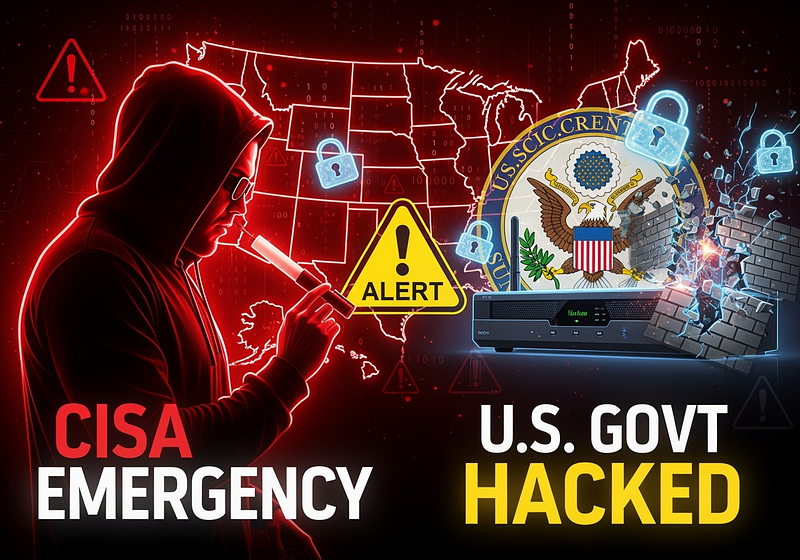
Firewalls, especially devices made by market leaders like Cisco, are often thought of as bastions of network defense. Edge defense, traffic filtering, VPN termination, inspection, segmentation, logging. You name it. But what if the gatekeeper itself is compromised, subverted, or backdoored deep in its boot code? That’s exactly the nightmare that unfolded in the “Cisco firewall exploitation” campaign that now grips the U.S. federal cyber posture.
When the U.S. Cybersecurity and Infrastructure Security Agency (CISA) issued Emergency Directive 25–03 (ED 25–03) on September 25, 2025, it was a signal: the attackers had crossed a boundary that’s supposed to be sacred. What follows is our attempt to unpack how this happened, why it matters, how far it might reach , and what must be done next.

Technical Anatomy of the Attack
Let’s walk through the defenders’ worst nightmare: zero-day exploitation of firewall infrastructure, with deep persistence, stealth, and cross-device impact.
Vulnerabilities exploited
At the core of the incident are two (and possibly three) newly disclosed flaws in Cisco’s firewall product lines (ASA, some Firepower / FTD variants):
- CVE-2025–20333 : a remote code execution (RCE) bug. Cisco describes this as a buffer overflow in the VPN web server component of ASA / FTD, enabling an attacker (in some cases after authentication or chaining) to execute arbitrary code.
- CVE-2025–20362 : a privilege escalation / unauthorized access vulnerability. Exploitable even without valid credentials in certain configurations (e.g. URL path-normalization bypass in WebVPN) to access protected resources.
- CVE-2025–20363 is also disclosed by Cisco (CVSS ~ 9.0) but is not currently known to have been used in this campaign.
The combination of an RCE and privilege escalation component provides the attacker with both entry and elevation. Attackers have been observed chaining the two (bypass → RCE) to gain full device control.
Post-exploit tactics & persistence
What raises this campaign from “serious breach” to “existential threat” is how the perpetrators embed themselves in the firewall, persist across reboots or upgrades, and cloak their activity.
- ROM / Bootloader modification
In confirmed intrusions, Cisco says the attackers modified the device’s ROMMON (device bootloader / read-only memory area) to maintain footholds that survive firmware updates and reboots.
Normally, updating firmware or rebooting should flush volatile memory and restore a clean state. But a modified bootloader can reload malicious payloads or tamper with introspection routines before the OS even runs. - Evasion, anti-forensics, disabling logging
Attackers have actively disabled or intercepted logging mechanisms, suppressed detection trails, manipulated CLI commands, and in some cases intentionally crashed devices to thwart forensic analysis.
For instance, Cisco describes that statisticians and forensic teams found that autocomplete/tab commands (e.g. tab completion) had been hooked to cause crashes, likely as traps for defenders. - Selective target model exploitation
Not all Cisco ASA/FTD devices are equally vulnerable. The campaign has successfully compromised older ASA 5500-X series models (e.g. 5512-X, 5515-X, 5525-X, 5545-X, 5555-X, 5585-X) , especially those not supporting “Secure Boot / Trust Anchor” capabilities.
Models already at end-of-support or being sunsetted (or soon to be) tend to lack hardware protections and thus are prime targets. - Malware families observed
The UK’s National Cyber Security Centre (NCSC) has published analysis of malware tied to these attacks: RayInitiator (a bootkit/bootloader component) and LINE VIPER (shellcode loader / payload delivery).
These malware components facilitate command & control, payload staging, and covert traffic.

Attack chain
Here’s one plausible (and partly reconstructed) attack path:
- Attacker scans public-facing Cisco ASA / FTD appliances (especially WebVPN/HTTPS endpoints).
- Exploits CVE-2025–20362 (privilege bypass / authentication bypass) to gain initial foothold in the VPN web component.
- Then triggers CVE-2025–20333 to execute arbitrary code (with root privileges) via a crafted HTTPS request to the VPN web plane.
- Once in, the attacker drops a payload that manipulates ROMMON or boot components to ensure persistence.
- The attacker disables logging, intercepts CLI commands, sets traps (e.g. tab → crash), and subverts introspection or visibility.
- From the firewall, the attacker may monitor traffic, divert flows, implant further backdoors, pivot into internal networks, or exfiltrate data.
Because the firewall sits at the network boundary (ingress/egress), controlling it gives tremendous strategic advantage: visibility to internal traffic, ability to block security updates, route or mirror packets, and act as a stealthy chokepoint.

Root Causes & Systemic Weaknesses
This attack did not emerge in isolation; it exploited deeper structural issues and legacy assumptions. Here are key root causes and enabling conditions.
Legacy hardware, end-of-support, and architectural debt
A number of targeted platforms were already end-of-support or approaching sunset (e.g. ASA 5500-X models). These devices lacked more modern protections (Secure Boot, hardware root of trust) — meaning attackers had more freedom.
Organizations often allow legacy gear to linger in production due to budget, compatibility, or inertia , but that becomes a predictable liability.
Overexposed management interfaces
Firewalls often host web or VPN interfaces for administrative access (often HTTPS), sometimes exposed to the public internet for remote access. Attackers can probe those surfaces. Lax segmentation, weak access control, or overprivileged exposure increases risk.
Delayed vulnerability patching & disclosure
Cisco apparently was called in by U.S. federal agencies to assist with attacks as early as May 2025; yet, public disclosure of the zero-days and attendant patches came only in September 2025.
Attackers had months of potential dwell time (or at least observation) before mitigations were broadly available.
Weak forensic readiness and visibility
Because these firewalls had been subverted, defenders may not have had perfect visibility into altered memory states or logging. Anti-forensic techniques (log suppression, command trapping) further hindered detection. Once the attacker is “in”, it becomes extremely difficult to discern their presence, especially in core networking gear.
Nation-state espionage motivations & resource backing
The sophistication (bootloader tampering, stealth, multi-stage malware) points to a resourceful actor (or state-backed group). Cisco, CISA, and third parties link it to ArcaneDoor / Storm-1849 / UAT4356 campaigns observed since 2024.
Such actors are capable of extended reconnaissance, custom tooling, and high operational security , making them far tougher adversaries than generic cybercriminals.

Political, Economic & Strategic Impacts
This is not just a “technical breach” story. The consequences ripple across national security, trust, economics, and geopolitical posturing.
Erosion of trust in critical infrastructure
Federal agencies rely on Cisco gear for core network security. That these devices themselves can be undermined shakes confidence not just within government but across enterprises, critical infrastructure, and allied institutions. If the “walls” are compromised, defenders fear for everything behind them.
Espionage & intelligence gathering
Given that exfiltration, traffic inspection, lateral pivoting, and manipulation of routing are within the attacker’s toolbox, the motive likely includes intelligence collection (communications, sensitive internal traffic), reconnaissance, or selective data theft (rather than pure ransomware or financial theft). For government networks, that may mean diplomatic, defense, policy, or classified data compromise.
Incentive for arms race in cyber capabilities
The scale and stealth of this campaign likely stoke urgency in offensive and defensive cyber capabilities, both in the U.S. and in other nations. Nations may accelerate investment in zero-trust architectures, chip/hardware security, and in “hack back” or active defense postures.
Economic cost & remediation burden
Fixing, patching, replacing legacy infrastructure, hiring forensic teams, running threat hunts, emergency upgrades — all cost money. Some agencies may have to rip and replace entire firewall fleets. These costs divert funds from other initiatives. Moreover, vendor liability, insurance claims, and possible regulatory fallout may impose further financial burden.
Diplomatic attribution and escalations
While official U.S. agencies have not publicly pinned a particular nation-state, private researchers (e.g. Censys) and media point to Chinese-based infrastructure correlations (which China denies).
Attribution carries diplomatic risk: cybersecurity retaliation, sanctions, or counterintelligence responses may follow. As this campaign comes amidst broader geopolitical tensions, it can become part of larger cyber cold wars.
Supply chain and vendor liability spotlight
Vendors of critical network gear may face escalating demands for built-in hardware root of trust, secure boot, integrity verification, transparency in code, and accountability. The breach raises scrutiny of “trusted hardware” assurances and supply chain integrity. Customers will expect stronger guarantees from Cisco and competitors, and procurement rules may shift in response.

What CISA Directed & the Immediate Response
Before jumping to recommendations, it’s worth summarizing what the U.S. response has been so far.
Emergency Directive ED 25–03 & associated guidance
CISA’s directive is sweeping and urgent. Among its key demands:
- Inventory all Cisco ASA and Firepower / FTD devices in agency networks (public-facing and internal).
- Forensic collection / core dumps: Agencies must collect memory dumps and diagnostic outputs and submit to CISA for analysis.
- Disconnect or quarantine end-of-support devices (especially those reaching end-of-life by Sept 30)
- Apply patches / upgrades to in-service devices immediately.
- Mitigation / eviction strategies via tools Cisco and CISA provide.
- Reporting and compliance accountability: Agencies must submit inventories, findings, and status back to CISA within tight deadlines (e.g. by October 2, 2025).
CISA also released “Supplemental Direction: Core Dump & Hunt Instructions” which contain step-by-step forensic commands, cautions (e.g. avoid using CLI autocomplete), and upload procedures.
Both vulnerabilities (CVE-2025–20333, CVE-2025–20362) have been added to CISA’s Known Exploited Vulnerabilities (KEV) catalog, which forces agencies to treat them as highest priority.
Public statements and attribution posture
- Cisco, in its security advisories and event response blogs, has confirmed that the attack links to the earlier ArcaneDoor campaign first publicized in 2024.
- Cisco emphasizes that in observed compromises, configurations, logging, and CLI behavior were tampered with, complicating detection.
- Both CISA and Cisco encourage all public and private sector organizations (not just federal) to follow the directive’s mitigations.
- While U.S. agencies have not publicly pinned culpability on a specific state, media and analysts point to Chinese infrastructure correlations (though China denies involvement)
Security Recommendations & Lessons Learned
Given the severity, this incident should be a turning point — not just a frantic patch fest. Below are defense-in-depth recommendations and longer-term lessons.
Short-term / tactical / incident response
- Treat firewall control plane as untrusted after compromise
In suspected or confirmed intrusions, assume that firewall configuration, credentials, routing tables, or telemetry have been manipulated. Plan to rebuild from known good states. Cisco explicitly notes that “all configuration elements should be considered untrusted.” - Prioritize patching & firmware upgrades immediately
Apply the security updates Cisco released that address these CVEs. For devices already compromised, the update process also includes integrity checks of ROM/bootloader to purge persistence. - Evict persistence consistently & validate integrity
After patching, validate devices via integrity checks, reflash firmware from trusted sources, validate bootloader, disable backdoor remnants, and reconfigure from scratch if necessary. Use CISA/Cisco eviction strategies. - Isolate or retire end-of-support hardware
Devices that lack modern protections (Secure Boot, Trust Anchor) or are beyond vendor support should be isolated or replaced hastily. - Forensic memory acquisition and collaborative threat hunting
Use the CISA supplemental core dump / artifact instructions (ED 25–03) meticulously, avoiding Autocomplete traps, capturing consistent memory dumps, logging, and telemetry. Share findings with central bodies (e.g. CISA’s Malware Next Generation). - Reassess firewall exposure & reduce attack surface
- Disable WebVPN / HTTPS admin interfaces on public-facing interfaces when possible
- Restrict management interfaces to whitelisted networks
- Enforce multi-factor auth, role separation, and hardened credentials
- Apply segmentation: treat firewall management network as a separate hardened zone
- Augment detection & monitoring at upstream / internal layers
Because the firewall may no longer be fully trusted, shift detection to adjacent systems: IDS/IPS, network tap monitoring, endpoint anomaly detection, flow analytics, and zero-trust principles inside the network.
Mid- to long-term strategic controls
- Adopt zero-trust network architecture (ZTNA)
Move away from trusting network perimeter devices implicitly. Segment laterally, require identity-based segmentation, least privilege access, continuous verification, and limit the blast radius if a perimeter device is compromised. - Harden hardware trust anchors in future acquisitions
All future firewall or network appliances should include strong hardware root-of-trust, secure boot, immutable bootloader protections, attestation, and defenses against ROM modification. - Maintain a proactive patch & vulnerability disclosure cadence
Vendors should accelerate detection-to-disclosure cycles, provide hotfixes, and coordinate with national cybersecurity agencies. Shadowing the vulnerability window is unacceptable for critical infrastructure. - Forensic readiness and incident playbooks for core network gear
Organizations should predefine forensic toolkits, collection playbooks, memory dump capabilities, secure chain-of-custody, and central coordination for network infrastructure (not just endpoints). - Threat intelligence sharing & collaborative red-teaming
More public/private sharing of APT tradecraft (e.g. ArcaneDoor) helps raise collective defense. Encourage periodic red-teaming of core network infrastructure by skilled adversary emulators. - Audit & retire “shadow” legacy gear across networks
Many large deployments harbor forgotten or lightly managed firewall or VPN appliances. Conduct audits, retire, or replace them before attackers exploit their neglect. - Vendor accountability & procurement policy reform
Government and enterprise procurement standards should require security certifications, built-in protection for firmware, mandatory patch support, secure update channels, and contractual liabilities for latent vulnerabilities.
Outlook & What to Watch
- Broader spillover to private sector: Although the directive currently targets U.S. federal agencies, the same vulnerabilities affect many enterprises, telecom, critical infrastructure, and academia. Expect ripple effects and increased attacks outside government.
- Rapid weaponization by other adversaries: Once patches are public, less sophisticated threat groups often reverse-engineer for copycats. We could see mass scans and exploitation of the same flaws in the wild.
- Focus shift to upstream firmware / supply chain attacks: Adversaries may increasingly target vendors’ firmware images or bootloaders, rather than just “software bugs,” because those afford deeper persistence.
- Attribution pressure & countermeasures: Political discourse will intensify over whether a state actor (e.g. China) is responsible. Responses may include sanctions, retaliatory cyber operations, or diplomatic escalation.
- Regulatory and insurance implications: Expect discussions about minimum cybersecurity standards for vendors, mandatory breach disclosure laws, and expanded cyber liability insurance demands.
Conclusion
In a way, this incident is poetic. Firewalls are meant to be unbreachable bastions, preventing the world from poking into your network. But here, the firewall became the weapon, the pivot, and the hiding spot. The very throat of the network was commandeered.
This campaign underscores a painful paradox: as your outer defenses become more fortified, attackers shift deeper , to the infrastructure itself. You can defend the gates, but if the gate’s hardware is compromised, defense becomes illusion.
Defenders must therefore accept that no single device or perimeter is sacred. Instead, resilience, segmentation, transparency, and compartmentalization become your bulwarks. The war has moved below Layer 7; now we must secure the firmware, the bootloader, and the trust anchors.