The Jaguar Land Rover Cyber Incident — An Analyst’s Perspective
Introduction

Introduction
When Jaguar Land Rover (JLR) officially confirmed that a cyber-attack had disrupted global operations, I immediately recognized that this was more than a headline, it’s a case study in how fragile the automotive supply chain has become in the face of modern threat actors. Production sites in the UK and abroad remain offline, data may have been exfiltrated, and regulators are now involved.
Let me walk you through my perspective on what we’re seeing.

Technical Analysis
From the initial reports and screenshots shared by the attackers, a few things stand out:
- Initial Access Vectors: Groups like Scattered Spider and Lapsus$ are notorious for social engineering employees, convincing helpdesk staff to reset MFA, phishing contractors, or leveraging SIM-swapping. I’d bet the foothold came from credential theft and MFA bypass, not some zero-day.
- Privilege Escalation: Once inside, attackers often rely on living-off-the-land tools (e.g., PowerShell, PsExec, Mimikatz). The internal screenshots suggest they escalated quickly and reached sensitive production systems.
- Operational Disruption: Shutting down production lines signals ransomware or deliberate sabotage of manufacturing IT/OT systems. Even if encryption wasn’t fully deployed, JLR clearly couldn’t risk continuing operations.
- Data Exfiltration: The claim of stolen data is credible. Groups like ShinyHunters specialize in selling internal data dumps, so regulators and affected individuals being notified means sensitive employee, customer, or partner data was likely accessed.
From a SOC perspective, what worries me most is that the attackers managed to move laterally across a globally distributed enterprise network. That doesn’t happen unless there were gaps in segmentation and monitoring.
Hackers’ Profile
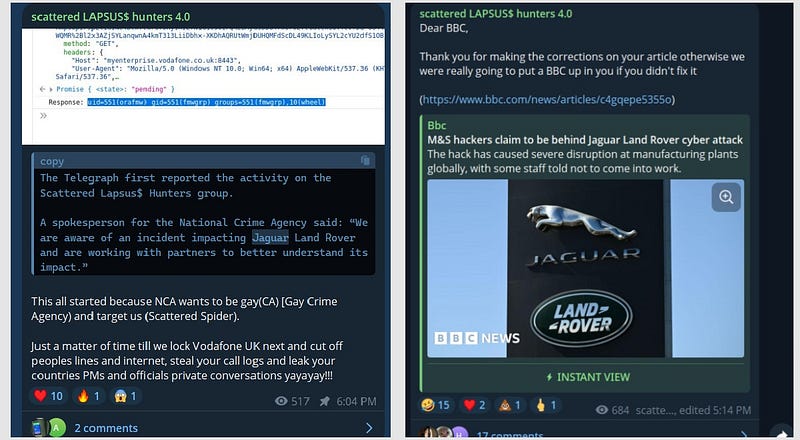
The names here, Scattered Spider, Lapsus$, ShinyHunters, and Hellcat, aren’t random.
- Scattered Spider: Known for English-speaking members, often targeting helpdesks, telecoms, and major enterprises. They’re disciplined in social engineering.
- Lapsus$: Famously reckless. They thrive on clout, leaks, and Telegram bragging. Screenshots posted by “Rey” fit the same MO.
- ShinyHunters: More profit-driven. They prefer data theft and resale on dark markets.
- Hellcat / “Rey”: If this attribution holds, it’s another case of splintered groups overlapping. Threat actors often hop between banners, sometimes for ego, sometimes for misdirection.
The unifying factor: these are young, English-speaking, aggressive groups that prioritize publicity and chaos as much as money. Unlike traditional Eastern European ransomware crews, they don’t always encrypt first, they often dump data and brag to amplify pressure.
Political and Economic Impact
This isn’t just a corporate IT outage. The fallout stretches wider:
- UK Economy: JLR is one of Britain’s flagship manufacturers. Production stoppages ripple across suppliers, logistics partners, and dealerships. Even a week offline translates to millions in lost revenue and delayed exports.
- Regulatory Scrutiny: With data compromise confirmed, regulators in the UK (ICO) and EU will demand GDPR compliance. Fines and mandatory audits could follow.
- Reputational Damage: For customers and investors, the incident raises trust questions. Who wants to hand personal data to a company making headlines for leaks?
- Political Dimension: Attacks on critical industries like automotive aren’t just cybercrime, they erode confidence in national resilience. When you see JLR, a household name, brought to its knees, it becomes a political talking point on the UK’s ability to defend its digital economy.

The Security Recommendations
From my analyst chair, here are the core takeaways for JLR and any enterprise watching closely:
Reinforce Identity Controls
- Eliminate SMS-based MFA; move to phishing-resistant methods (FIDO2 keys, passkeys).
- Tighten helpdesk procedures, verify identity through multiple channels before resets.
Segment IT and OT
- Manufacturing environments should not be flat. Strong segmentation reduces blast radius when attackers get inside.
Adopt Continuous Monitoring
- SOC teams need visibility into lateral movement. Tools like EDR/XDR and anomaly-based detection are critical.
Data Loss Prevention (DLP) and Zero Trust
- Assume breach. Limit who can access sensitive systems and what they can extract.
Tabletop Exercises & Crisis Comms
- Incidents like this show that response speed and clarity matter as much as defenses. Companies must practice comms with regulators, staff, and media before they’re forced to do it under fire.

Final Thoughts
What happened to JLR isn’t an isolated event, it’s a reflection of the evolving cybercrime landscape. We’re dealing with attackers who blend social engineering, data theft, and disruption into a playbook that hits both wallets and reputations.
As an analyst, I see this incident as a loud warning: if even industry giants with complex security programs can be halted for weeks, no organization can afford to treat cybersecurity as a back-office function. The line between IT downtime and national economic impact has never been thinner.