SHAMOS macOS Malware Explained: The Infostealer You Can’t Ignore
Introduction

Introduction
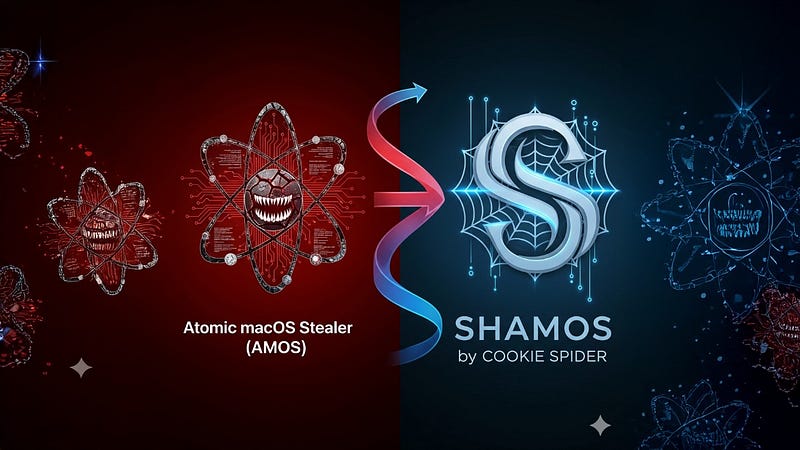
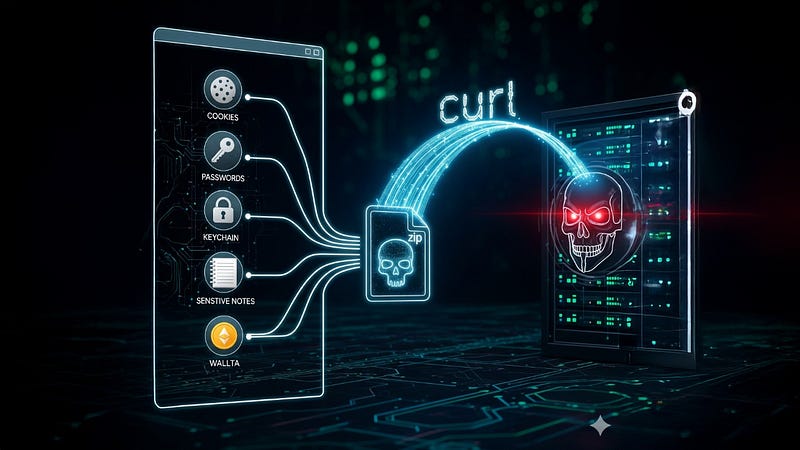
Between June and August 2025, a criminal crew CrowdStrike tracks as COOKIE SPIDER ran a global malvertising operation that pushed SHAMOS, a variant of Atomic macOS Stealer (AMOS), to Mac users. Ads and fake “Mac help” pages (and a spoofed GitHub repo) told victims to paste a single Terminal command (“ClickFix” style) that silently fetched a Bash installer, bypassed Gatekeeper, dropped a Mach-O payload in /tmp/, and raided browsers, Keychain, Apple Notes, and crypto wallets before exfiltrating a zipped bundle via curl.
CrowdStrike reports 300+ environments were targeted/attempted; the campaign avoided Russia/CIS, consistent with typical e-crime forum rules.

Threat actor & campaign profile
Attribution. SHAMOS is operated within COOKIE SPIDER’s malware-as-a-service (MaaS) business built around AMOS. The crew monetizes by renting the stealer and by converting stolen credentials and crypto.
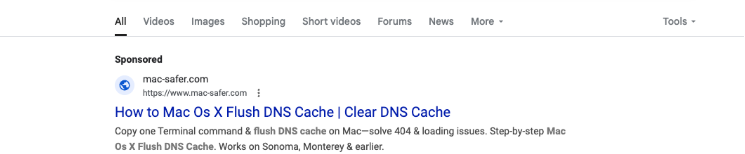
Distribution & lures. Users searching for fixes like “macOS flush DNS cache” were shown paid search ads for cloned “help” sites (examples observed: mac-safer[.]com, rescue-mac[.]com) or a fake GitHub repo posing as iTerm2. Those pages instructed victims to paste a one-liner into Terminal, the hallmark of a ClickFix attack.
Victimology & scope. CrowdStrike saw attempted delivery in 300+ customer environments across the U.S., UK, Japan, China, Colombia, Canada, Mexico, Italy and more; no Russian targets were observed.
Technical analysis
Initial access (ClickFix one-liner)
- Fake help/GitHub pages present a single command. In observed cases it Base64-decodes a URL and pulls a Bash script from attacker infrastructure (e.g.,
icloudservers[.]com/gm/install.sh). - This pattern aligns with broader ClickFix social engineering: lure → copy/paste command → user-assisted execution. (Microsoft and others have warned ClickFix surged in 2025.)
Installation
- The script:
- Captures the user’s password (prompted by
sudo/similar). - Downloads the SHAMOS Mach-O to
/tmp/, clears quarantine bits viaxattr(Gatekeeper bypass), setschmod +x, and executes.
Defense evasion & runtime behavior
- Anti-VM/sandbox checks before proceeding.
- AppleScript-driven host recon and file collection.
- Collection targets confirmed: browser data (passwords/cookies/auto-fills), Keychain items, Apple Notes, and crypto-wallet artifacts.

Exfiltration
- Data staged into
out.zipand sent viacurlto actor-controlled endpoints.
Persistence & follow-on payloads
- On systems where the installer gains elevated privileges, it writes a LaunchDaemon
com.finder.helper.plistfor persistence. - Observed secondary payloads include a spoofed Ledger Live wallet app and a botnet module.
Infrastructure & IOCs (selected)
- Malvertising/landing domains:
mac-safer[.]com,rescue-mac[.]com - Downloader hosts:
icloudservers[.]com,macostutorial[.]com - GitHub decoy:
github[.]com/jeryrymoore/Iterm2 - Local artifacts:
/tmp/<random>Mach-O,out.zip, LaunchDaemoncom.finder.helper.plist

Who was hit?
Public sources have not named specific organizations. What we do know is:
- The scale (300+ attempted environments) and breadth of geography are confirmed.
- Lures imitated generic Mac troubleshooting and popular software categories (video editing, CAD, “performance tools,” AI/dictation), indicating broad, opportunistic targeting rather than a single vertical. (Inference based on CrowdStrike’s observed decoys.)

Political & economic impact
Economic
- Direct losses: crypto theft and account takeovers from stolen Keychain/browser data.
- Indirect losses: Business email/session hijacking, downstream breaches, incident response costs, password resets, and ad-fraud exposure if ad/marketing accounts are compromised. These are consistent with infostealer outcomes and explicitly supported by the data types SHAMOS steals.
Political / policy
Platform trust: Bypassing Gatekeeper via user-paste commands challenges perceptions of macOS security and may spur OS-level guardrails against risky one-liners. (Supported by multiple outlets summarizing the bypass method.)
Ad ecosystem abuse: The campaign leveraged paid search ads and spoofed biz profiles, fueling calls for stronger advertising vetting and anti-malvertising controls.
Technique normalization: ClickFix is now used by both e-crime and some APT actors, blurring crime/state TTPs and complicating attribution at scale.
Start learning cyber security by enrolling in courses provided by top universities and tech giants:

MITRE ATT&CK mapping (high level)
- Initial Access: T1189 (Drive-by via malvertising), T1204.002 (User Exec: Malicious command)
- Execution: T1059 (Command Shell), T1059.004 (Bash), T1059.002 (AppleScript)
- Defense Evasion: T1562, T1553.001 (Gatekeeper quarantine removal with
xattr) - Credential Access / Collection: T1555.001 (Keychain), T1005 (Local files), T1539 (Browsers)
- Exfiltration: T1041 (Exfil over C2 channel) using
curl - Persistence: T1543.001 (LaunchDaemons)
Detection & hunting ideas (macOS)
Tailor paths and tooling to your EDR/SIEM.
Command-line signals
- Terminal/bash/zsh history containing
base64 -d,curl ... | bash, or one-liners fetchinginstall.shfromicloudservers[.]com/macostutorial[.]com. xattr -d com.apple.quarantinefollowed bychmod +xon a file under/tmp/.- AppleScript/osascript invocations enumerating files/keystores.
Filesystem & artifacts
- Presence of
/tmp/<random>Mach-O executed recently. ~/Library/LaunchDaemons/com.finder.helper.plist(or similarly named) with recentlaunchctlloads.- Recent creation of
out.zipunder user directories or/tmp/.
Network
- DNS/HTTP(S) to
mac-safer[.]com,rescue-mac[.]com,icloudservers[.]com,macostutorial[.]comaround the time a user reported “copy/pasting a fix.”
Prevention & hardening (what to do now)
For security teams (enterprise & SMB)
Block risky one-liners by policy
- Add controls in MDM/EDR to alert on/contain Terminal one-liners that fetch from the internet (e.g.,
curl|bash,bash -c "$(curl …)",base64 -d | bash").
Tighten Gatekeeper/Quarantine flows
- Monitor and alert on
xattr -d com.apple.quarantineoutside approved installers.
DNS & web filtering
- Enforce safe search/ad filters; block or closely inspect sponsored results; sinkhole known SHAMOS IOCs.
EDR coverage
- Ensure behavior rules catch AppleScript reconnaissance, zip + curl exfil, and LaunchDaemon creation. CrowdStrike and others document detections for this chain.
Least privilege
- Prevent routine access to
sudoon user devices; SHAMOS persistence relied on elevated contexts.
Developer tooling controls
- Curate approved GitHub/orgs and Homebrew taps; flag clones/unknown repos, since a fake iTerm2 repo was abused.
User education (just-in-time)
- Teach “never paste commands you don’t understand.” Add in-terminal banners or MDM pop-ups reminding users to route fixes through IT.
For individual Mac users & small teams
- Do not paste Terminal fixes from search results or random GitHub gists.
- Go to official docs (Apple Support/communities) or your IT team for troubleshooting.
- Install from App Store or signed developers you know; keep macOS updated.
- Use a reputable endpoint tool that inspects scripts and blocks known IOCs.
Incident response playbook (SHAMOS-suspected)
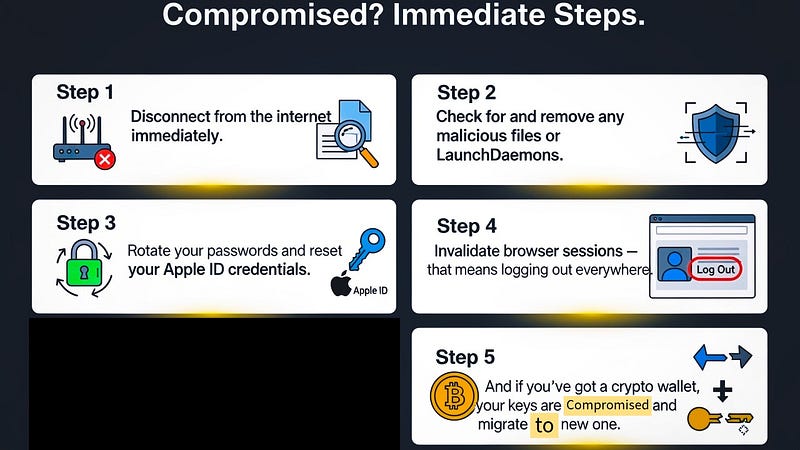
Isolate the Mac (network off, especially Wi-Fi).
Acquire volatile data (process list, network connections) and preserve /tmp/, LaunchDaemons, and shell histories.
Hunt & contain
- Remove suspicious LaunchDaemons (e.g.,
com.finder.helper.plist) and binaries in/tmp/. - Blocklisted domains/IPs above; search for
out.zipcreation.
Credential reset & session hygiene
- Rotate Keychain, browser-stored passwords, Apple ID, corporate SSO; invalidate sessions/cookies (force logouts); treat crypto wallets/seeds as compromised.
Forensics to determine persistence and any follow-on payloads (e.g., fake Ledger app, botnet module).
Report malvertising placements to your ad vendor and share telemetry with your ISAC.
Why SHAMOS matters
- It industrializes a reliable social technique (ClickFix) against macOS.
- It shows Gatekeeper bypass by design, not a vuln, when users paste commands.
- It pairs credential/crypto theft with the ability to drop more malware, elevating both immediate financial risk and long-tail business compromise.
References
Most-relevant technical primary source:
- CrowdStrike’s engineering & intel write-up with commands, infra, and geography.