CVE-2025–64446 | The FortiWeb Vulnerability Everyone Slept On
When security teams think edge device compromise, they usually imagine firewalls, VPN appliances, or exposed RDP endpoints. What they…

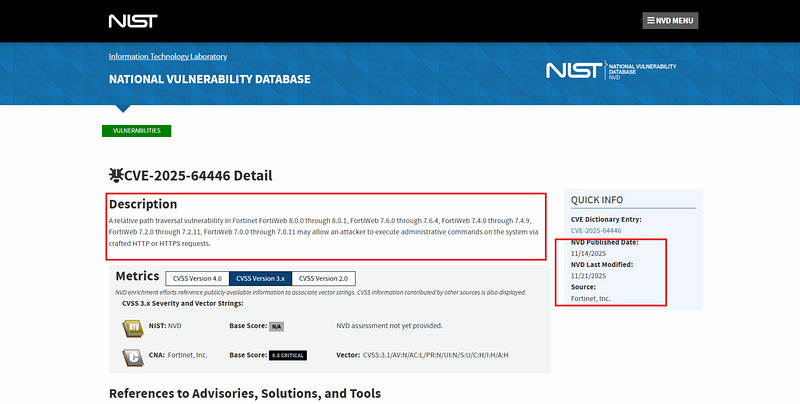
When security teams think edge device compromise, they usually imagine firewalls, VPN appliances, or exposed RDP endpoints. What they rarely expect is the very tool meant to protect their web apps quietly becoming the attacker’s entry point. That’s exactly what CVE-2025–64446 represents , a high-impact vulnerability in Fortinet’s FortiWeb, a widely deployed Web Application Firewall used across enterprises, hosting companies, and government networks.
And yes this CVE has already entered the Known Exploited Vulnerabilities list, which means attackers are actively abusing it.
Let’s break it down properly.
Technical Deep Dive
CVE-2025–64446 is a path traversal vulnerability in FortiWeb, triggered through improperly validated user-supplied parameters inside specific HTTP requests.
In simple terms: FortiWeb fails to sanitize certain URL paths. An attacker can abuse this to read arbitrary files outside the intended directory.
Technical Behavior
- The risk comes from directory traversal using sequences like:
../../../../etc/passwd - The vulnerable endpoint allows attackers to pass crafted path strings.
- The appliance doesn’t enforce proper canonicalization or base-path constraints.
- As a result, they can force FortiWeb to return sensitive system files, templates, configuration details, SSL keys, or backend connection parameters.
The vulnerability:
- Does not require authentication in many configurations.
- Works over normal HTTP/HTTPS traffic, making attacks hard to differentiate from normal client requests.
- Provides a stepping stone to more severe exploits: reading private keys → decrypting traffic → lateral movement.

Why it’s dangerous from an exploit dev perspective
A path traversal on a WAF isn’t just a file disclosure issue, it’s a trust boundary violation on a device that inspects, logs, filters, and proxies highly sensitive application traffic.
Attackers can extract configuration files containing database credentials, steal SSL private keys for man-in-the-middle attacks, read system files that reveal OS version, package versions → used to pivot into RCE or privilege escalation and Identify backend architecture to plan follow-up attacks.
A seasoned attacker uses this as a reconnaissance booster before escalating to RCE via another FortiWeb or OS-level flaw.

Impact
Let’s be blunt: On a WAF, file disclosure is already a compromise of trust.
✔️ Direct Impact
- Exposure of configuration files
- Leakage of internal IP addresses
- Compromise of backend authentication parameters
- Disclosure of SSL private keys, enabling traffic decryption
- Exposure of admin usernames, log settings, debug info
✔️ Indirect / Secondary Impact
If attackers retrieve certain files, they can escalate to:
- Remote Code Execution via known appliance-side flaws
- Credential harvesting inside protected internal networks
- Application impersonation attacks
- Persistent MITM on HTTPS traffic
- Complete WAF bypass (attackers tailor payloads knowing ruleset internals)
✔️ Real-world implications
FortiWeb often sits in front of:
- Banking portals
- Government online services
- Healthcare applications
- eCommerce platforms
- Multi-tenant hosting environments
A compromise here becomes a single point of failure with cascading consequences.
Cyber Security Notes and Cheat Sheets

Indicators of Compromise (IOCs)
Since exploitation happens over public HTTP endpoints and looks like normal traffic, detecting attacks requires focusing on anomalies.
Log-Based IOCs
Look for:
../
../../
../../../
%2e%2e%2f
..%2f..%2f..%2f
Encoded or double-encoded traversal attempts:
%252e%252e%252fSuspicious requests to:
/api//diag//config//report//logs//download/endpoints
Unexpected access to:
/etc/passwd/etc/shadow/proc/self/environ- SSL certificate key paths
Suspicious Behavior Patterns
- Large bursts of file download requests in short windows
- Requests containing traversal followed by valid system file paths
- Unknown IPs enumerating directory structures
- Repeated probing attempts across multiple endpoints
Network-Level IOCs
- Requests with crafted path payloads (manual or automated)
- Traffic spikes on rarely used administrative endpoints
- Behavior consistent with automated scanners (single IP, rapid bursts)

Patching & Mitigation
1. Apply the Vendor Patch Immediately
Fortinet’s advisory provides the patched firmware build, upgrading is the only proper fix. WAF appliances cannot rely on virtual patching alone because:
- The vulnerability is in the appliance itself
- Attackers bypass rules by exploiting underlying OS behavior
2. Virtual Hardening (Temporary Mitigations)
a. Restrict Access to Admin Interfaces
Via:
- Access control lists (ACLs)
- VPN-only access
- IP allow-lists
Do NOT expose FortiWeb admin panels to the internet.
b. Deploy Custom WAF Rules
Block requests containing:
../
..\
%2e%2e%2f
c. Disable Unused Interfaces & Services
Anything accessible externally should be explicitly required.
d. Segment the Appliance
Your WAF should never directly touch:
- Domain controllers
- Database servers
- Internal application servers without segmentation
A compromised WAF in a flat network = full breach.
e. Regenerate SSL Certificates if Key Exposure Is Suspected
If attackers accessed certificate files:
- Assume private keys are compromised
- Reissue certificates
- Revoke old ones
f. Review System Files
Check for:
- Modified configs
- Unknown scripts
- Unexpected cron jobs
- New users
- Strange binaries
Threat Hunting
1. ELASTIC / ELK STACK (KQL)
A. Detect Path Traversal Attempts
url.original: ("../" or "..\\" or "%2e%2e%2f" or "%2e%2e%5c" or "%252e%252e%252f")B. Look for Attempts to Access System Files
url.original: ("etc/passwd" or "etc/shadow" or "proc/self/environ" or "*.key" or "*.pem")C. Detect Abnormal Access to FortiWeb Admin/Diag Endpoints
url.path: ("/api/*" or "/diag/*" or "/config/*" or "/logs/*" or "/report/*")
and not source.ip in ("<internal_admin_IP_range>")
D. High-Volume Enumerations (Scanning Behavior)
event.dataset: "fortiweb*" and
event.action: ("GET" or "POST") and
url.original: ("../" or "%2e%2e%2f")
| stats count() by source.ip
| where count > 20
E. Double or Triple Encoding (Evasion)
url.original: ("%25%32%65%25%32%65%25%32%66" or "%252e%252e%252f")2. SPLUNK (SPL) Threat Hunting Queries
A. Path Traversal Detections
index=fortiweb_logs OR index=proxy_logs
(url="*../*" OR url="*..\\*" OR url="*%2e%2e%2f*" OR url="*%252e%252e%252f*")
B. Access to Sensitive Files
index=fortiweb_logs
(url="*/etc/passwd*" OR url="*/etc/shadow*" OR url="*/proc/self/environ*" OR url="*.key" OR url="*.pem")
C. Suspicious Endpoint Access
index=fortiweb_logs
(url="*/diag/*" OR url="*/config/*" OR url="*/report/*" OR url="*/logs/*")
| where NOT cidrmatch("10.0.0.0/8", src_ip)
D. Burst of Traversal Attempts (Recon Scanning)
index=fortiweb_logs url="*../*"
| stats count by src_ip
| where count > 15
E. Unusual HTTP Methods Trying Traversal
index=fortiweb_logs
method IN ("PUT","OPTIONS","HEAD","TRACE")
AND url="*../*"
3. MICROSOFT SENTINEL (KQL)
A. Detect Path Traversal Patterns
CommonSecurityLog
| where RequestURL has "../"
   or RequestURL has "%2e%2e%2f"
   or RequestURL has "%252e%252e%252f"
B. Sensitive File Access Attempts
CommonSecurityLog
| where RequestURL has "etc/passwd"
    or RequestURL has "etc/shadow"
    or RequestURL has "proc/self/environ"
    or RequestURL has ".key"
    or RequestURL has ".pem"
C. Suspicious FortiWeb System Endpoints
CommonSecurityLog
| where RequestURL matches regex @"\/(api|diag|config|report|logs)\/"
| where src_ip !in ("<admin_IPs>")
D. Scan Detection (High Frequency Same IP)
CommonSecurityLog
| where RequestURL has "../"
| summarize Attempts=count() by src_ip
| where Attempts > 20
E. Double/Triple URL Encoding
CommonSecurityLog
| where RequestURL has "%25%32%65"
   or RequestURL has "%252e%252e%252f"
Usage Notes for Threat Hunters
1. Combine queries with time-window analysis
Most scanners hit dozens or hundreds of endpoints within minutes.
2. Watch for attackers blending into normal traffic
CVE-2025–64446 exploits use:
- Standard GET requests
- No authentication
- No special headers
3. Extract user-agent anomalies
Add this filter in Splunk/Elastic/Sentinel:
user_agent IN ("curl", "wget", "python-requests", "Go-http-client")These are common in exploitation scripts.
4. Review logs for near misses
Even failed traversal attempts indicate reconnaissance.

Conclusion
CVE-2025–64446 is a reminder that security appliances are software, and therefore exploitable like anything else. In fact, when the vulnerable system sits at the perimeter, the stakes are even higher.
This flaw isn’t theoretical it’s already being abused. And since it requires no authentication and little knowledge of the target, even low-skill attackers can weaponize it with off-the-shelf tools.
The good news? With patching, segmentation, and log monitoring, you can reduce the risk dramatically.